Research by Pei Feng Tong et al. on the Intelligent EEG Analysis Platform EEG-X Accepted for Publication
Recently, the research paper “EEG-X: An Integrated Framework for Automated Quantitative EEG Analysis in Epilepsy Diagnosis” by Professor Song Xi Chen’s team was accepted for publication in IEEE Journal of Biomedical and Health Informatics (IEEE JBHI), a top-tier journal in intelligent medicine.
Electroencephalography (EEG) is the gold standard for epilepsy diagnosis, while longer EEG monitoring and a growing patient population significantly increase neurologists’ workloads. In addition, differences in age, seizure type, electrode configuration, and acquisition equipment make it difficult for artificial intelligence models for seizure detection to generalize reliably to new patients. To address these challenges, this study proposed a seizure detection algorithm based on multimodal signals and multiscale feature extraction, significantly improving the accuracy and generalizability of seizure detection. The study further integrated seizure detection, spike detection, source localization, and other functions into EEG-X, an intelligent cloud platform for EEG analysis. EEG-X transforms the workflow from manual segment-by-segment review into “AI annotation of candidate abnormalities followed by rapid professional verification” and supports online multi-user viewing, label editing, and resolution of annotation conflicts.
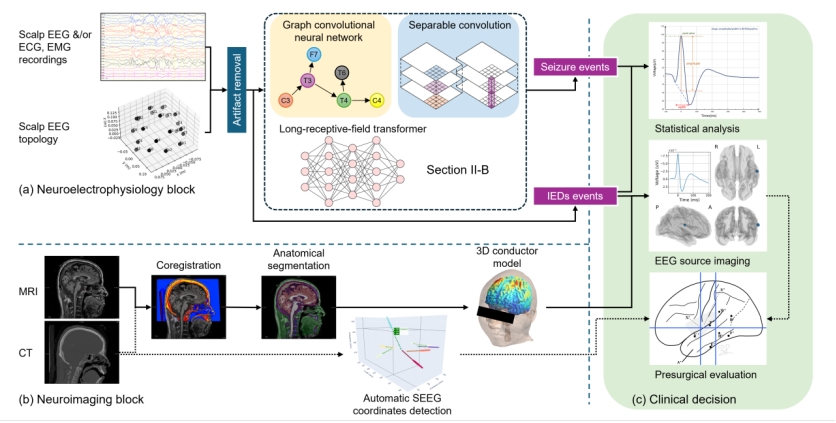
Figure 1. EEG-X, a full-process platform for epilepsy diagnosis and treatment. Following automated analysis, electrophysiological and imaging data provide a quantitative basis for statistical evaluation, EEG source imaging, and preoperative assessment.
The seizure detection algorithm proposed by the research team takes 30-s multimodal signals as input, including EEG signals, power spectral density (PSD) features, electrocardiography (ECG) signals, and electromyography (EMG) signals. For each modality, the signal is first processed using depthwise separable convolutions and a knowledge-driven graph convolutional network to jointly model relationships between adjacent electrodes and bilaterally symmetric brain regions, producing feature embeddings with spatial topological information. The multimodal features are then concatenated and fed into a multilevel Transformer Encoder module for long-range temporal feature modeling, ultimately producing second-by-second seizure detection labels.
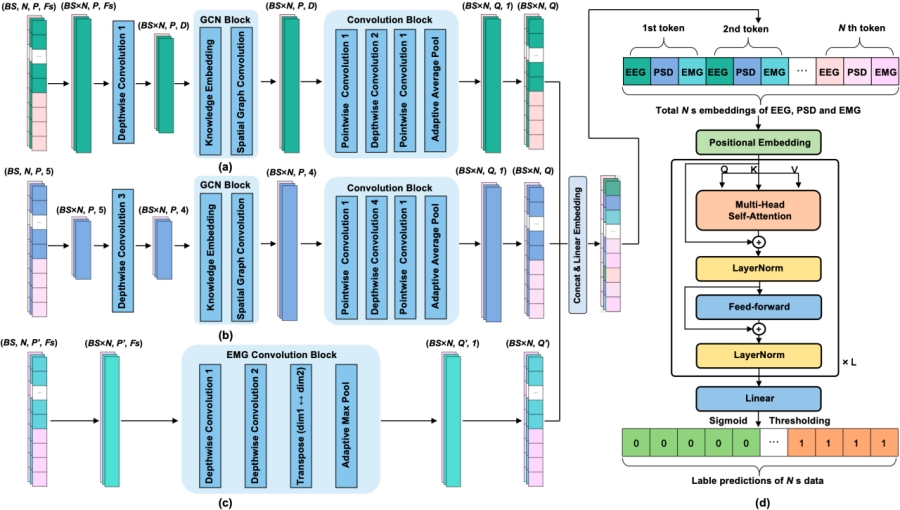
Figure 2. Architecture of the seizure detection model. EEG, PSD, and EMG/ECG features are extracted through dedicated convolutional and graph convolutional pathways and then fed into the Transformer as temporal tokens to output second-by-second labels.
This study combined the four public datasets TUSZ, CHSZ, HUH, and SSE with retrospective data from four hospitals in China to form a large-scale epilepsy dataset comprising thousands of patients. The study employed stratified 10-fold nested cross-validation with strict patient separation and compared EEG-X with six representative algorithms under the same protocol. Results show that EEG-X achieved the best performance on six of the seven metrics and struck a favorable balance among sensitivity, false-alarm control, and detection speed, demonstrating substantial potential for clinical application and the ability to significantly reduce clinicians’ EEG review workload.
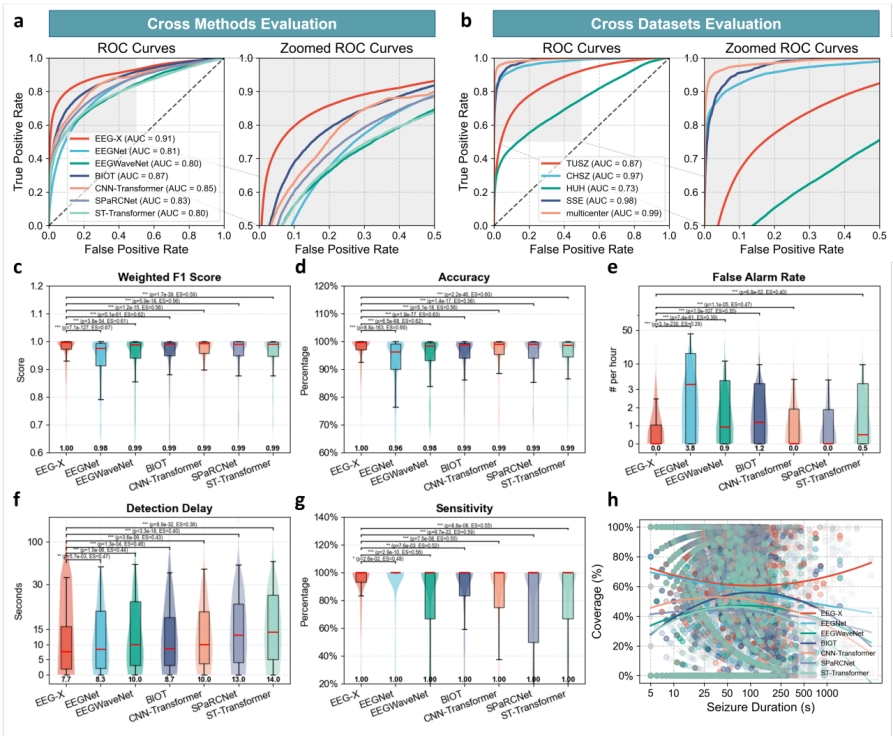
Figure 3. Cross-patient comparison of EEG-X with six existing algorithms and cross-dataset results.
In addition to seizure detection, EEG-X integrates modules previously developed by the team for interictal epileptiform discharge detection, EEG source imaging, artifact removal, high-frequency oscillation analysis, MRI/CT registration, three-dimensional head-model reconstruction, and SEEG electrode coordinate identification. It is now online at www.eeg-x.com and is publicly accessible. The platform can be accessed through web browsers on workstations, tablets, and mobile phones, and de-identifies EEG file headers and structural imaging data.
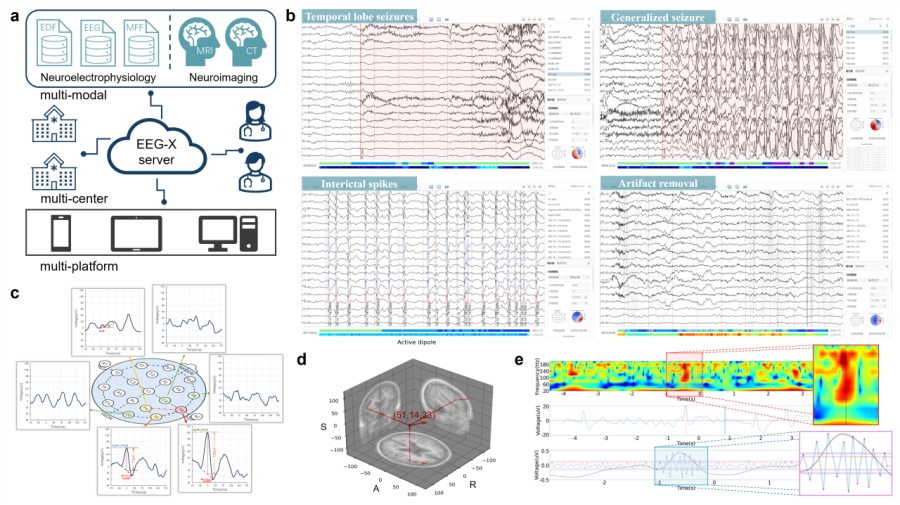
Figure 4. EEG-X cloud collaboration and examples of automated analyses, including seizure recognition, interictal spikes, artifact removal, source localization, and time-frequency analysis.
The first author of the paper is Pei Feng Tong, a postdoctoral researcher at the School of Aerospace Engineering, Tsinghua University; the second author is Long Zhang, a researcher at the Peking University Changsha Institute for Computing and Digital Economy; the third author is Dr. Bosi Dong of West China Hospital, Sichuan University; and Professor Song Xi Chen is the corresponding author. The study was supported by National Natural Science Foundation of China grants 12292980 and 12292983 and China Postdoctoral Science Foundation grant 2025M783114.