Research by Hao-Xuan Sun et al. on the Localization Estimation for High-Dimensional Tensor Covariance Matrices Accepted for Publication in The Annals of Statistics
Recently, the manuscript “Localization Estimator for High-Dimensional Tensor Covariance Matrices” by Hao-Xuan Sun, Song Xi Chen, and Yumou Qiu was accepted for publication in The Annals of Statistics. The paper addresses covariance matrix estimation for high-dimensional tensor data, proposes a multi-bandable covariance class and a localization estimator, and establishes the associated statistical properties.
In research areas such as geophysical data assimilation, medical imaging, and attention mechanisms, observations increasingly exhibit high-dimensional, multi-layer tensor structures. In “large p small n” settings, the sample covariance matrix is no longer consistent. Judicious use of the underlying covariance structure can improve the precision of the covariance estimation. Different from the bandable class commonly considered for vector data, covariance matrices for tensor data may exhibit heterogeneous decay rates across different directions and nonseparable structures. Developing covariance matrix estimation methods tailored to tensor data therefore not only extends the theory of high-dimensional covariance estimation but also provides a statistical foundation for scientific applications such as ensemble Kalman filter and medical discriminant analysis.
The study originated from an investigation of spatial correlations in daily temperature and salinity changes associated with ocean eddies in the western Pacific. Taking daily salinity increments as an example, as shown in Figure 1, after re-centering the eddy each day by aligning its center to the eddy center of the first day, the data form a three-order tensor indexed by longitude, latitude, and depth. The sample correlation matrix exhibits a detailed “bandable-in-bandable” structure, reflecting complex dependence across different spatial directions and providing direct motivation for studying covariance matrix estimation for high-dimensional tensor data.
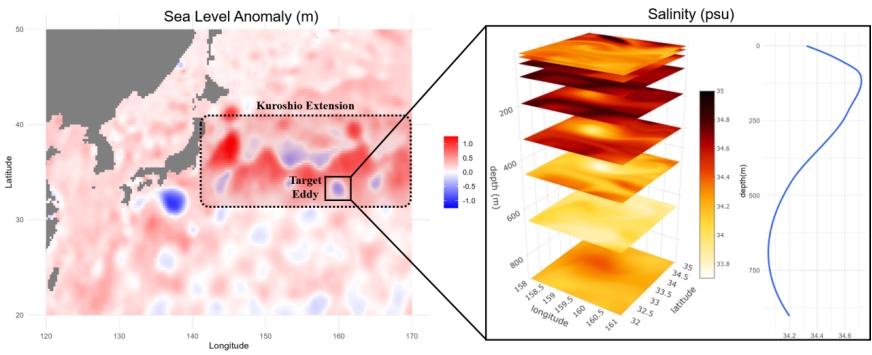
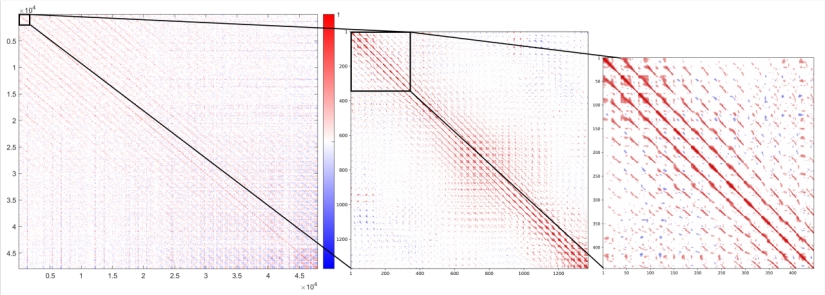
Figure 1. (a) Sea level anomaly of a mesoscale eddy in the western Pacific on September 1, 2024 (left), together with salinity fields at 10 depth levels and the vertical profile of mean salinity (right); (b) sample correlation matrix of daily salinity changes (left), the corresponding sample correlation matrix at the sea surface (middle), and a close-up of the region spanning 32°N–33°N and 158°E–161°E (right).
To address this problem, the paper first proposes a multi-bandable covariance class for tensor data , which allows nonseparable covariance matrices and heterogeneous decay patterns across tensor directions. It then develops a localization covariance estimator with general localization functions, which extends the classical consistent banding estimator in Bickel and Levina (2008) for high-dimensional vector data to general high-dimensional tensor data.
The paper then proves the consistency of the proposed estimator under the spectral and Frobenius norms and establishes estimator with general localization functions and establishes sharp convergence bounds that match the minimax rates under the multi-bandable covariance class. It also develops a data-driven adaptive localization estimator based on the Goldenshluger--Lepski method for selecting the scaling parameters, which achieves the same spectral-norm minimax optimal convergence rate without requiring prior knowledge of the covariance decay structure. Numerical simulations and a case study involving the reconstruction of salinity fields for a mesoscale eddy in the western Pacific illustrate the utility of the proposed method in practice.
The first author is Hao-Xuan Sun, a tenure-track associate professor at the School of Mathematics and the International Center for Interdisciplinary Statistics, Harbin Institute of Technology. This study is part of his doctoral dissertation at the Center for Big Data Research at Peking University. The coauthors include Professor Song Xi Chen, Hao-Xuan Sun’s advisor, and Associate Professor Yumou Qiu of the School of Mathematical Sciences and the Center for Statistical Science at Peking University. The study was supported by the NSFC Major Research Plan on West-Pacific Earth System Multispheric Interactions, the Fundamental and Interdisciplinary Disciplines Breakthrough Plan of the Ministry of Education of China, the NSFC Major Program.
The paper refers to: